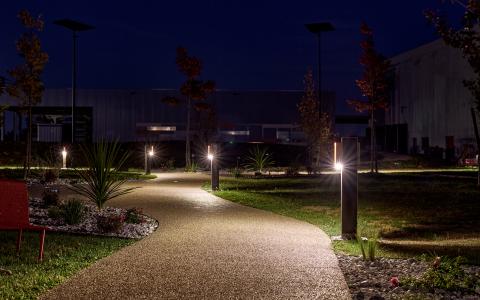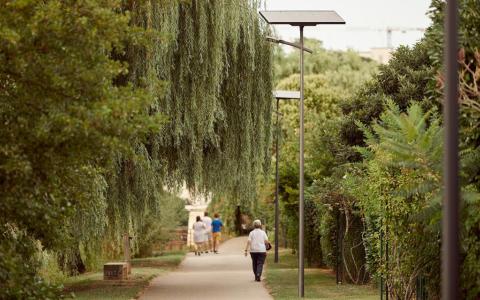

Solar public lighting: a sustainable, adaptable, and strategic solution for urban projects
In the face of the energy transition, increasing pressure on electrical grids, and growing budgetary constraints, local authorities and urban planners must rethink their lighting infrastructures.
In this context, solar public lighting stands out as a reliable and mature solution capable of addressing the energy, economic, and environmental challenges of modern cities.
Once considered an alternative, autonomous solar streetlights have now become a structuring lever for urban projects, whether in city centres, heritage areas, or developing districts.
A Proven Technology Serving Urban Lighting
Solar streetlights operate using photovoltaic modules that capture solar energy, store it in integrated batteries, and power high-performance LED light sources at night.
This off-grid operation enables:
-
full autonomy, without connection to the electricity grid
-
simplified installation, with no trenches or cabling required
The most advanced solutions integrate intelligent energy management systems, including nighttime dimming, lighting scenarios, and motion sensors. These features adjust light output to actual usage while optimising energy consumption.
Major Economic Advantages for Local Authorities
Solar public lighting offers a highly attractive economic model for local authorities and public stakeholders.
With no grid electricity consumption, energy expenses are eliminated. Maintenance is limited thanks to robust components and the absence of heavy infrastructure.
Key economic benefits include:
-
elimination of grid connection and civil engineering costs
-
long-term reduction in operating expenses
-
rapid return on investment, often achieved within a few years
In many projects, local authorities report savings of up to 70% on the total cost of public lighting. This energy independence also strengthens the resilience of urban infrastructure, particularly during grid outages or emergency situations.
A Direct Contribution to Carbon Neutrality Goals
Public lighting represents a significant share of urban energy consumption, making its transformation a key lever for achieving climate objectives.
By using renewable, local, and carbon-free energy, solar public lighting enables:
-
a long-term reduction in CO₂ emissions
-
reduced dependence on fossil fuels
-
alignment with sustainable and smart city strategies
The gradual replacement of conventional luminaires with autonomous solar solutions significantly reduces the carbon footprint of urban lighting networks.
A Solution Adaptable to All Urban Contexts
One of the key strengths of solar public lighting lies in its adaptability to the specific constraints of each territory.
City centers and heritage areas
The absence of heavy construction works helps preserve soils, roadways, and protected spaces. Solar streetlights integrate discreetly into sensitive environments without altering urban landscapes or heritage assets.
Peripheral districts and underserved areas
In locations where the electricity grid is nonexistent or insufficient, solar lighting provides an ideal autonomous solution that is rapidly deployable and scalable.
This flexibility gives urban planners and developers a level of integration freedom that traditional systems cannot offer without significant investment.
A Common Foundation for Urban Projects with Diverse Constraints
Each urban project presents specific challenges: heritage preservation, respect for nighttime landscapes, tight deadlines, or complex worksites.
Solar public lighting provides a shared technological foundation capable of addressing these constraints while adapting to local realities.
In some projects, the challenge is to modernise public lighting without altering architecture or rebuilding public spaces. In others, the priority is limiting light pollution and visual impact.
For many local authorities, reducing construction timelines and simplifying coordination are decisive factor.
These challenges highlight the versatility of solar public lighting and explain its growing adoption in contemporary urban projects.
Large-Scale International Projects
Globally, solar public lighting has proven its relevance across highly diverse contexts:
-
Chile – Rutas del Loa Programme: more than 2,226 solar streetlights installed along 112 km of roads in the Atacama Desert
-
Cameroon – Yaoundé: lasting improvements to nighttime safety in several urban districts
-
Senegal – National Program: more than 120,000 solar streetlights deployed nationwide
These projects demonstrate solar lighting’s ability to support ambitious public policies across large and constrained territories.
A Mature Solution for the Cities of Tomorrow
Solar public lighting is no longer an emerging technology. It is now a reliable, proven, and strategic solution aligned with the needs of modern cities.
For local authorities, urban planners, and public or private decision-makers, integrating solar lighting into development projects represents a structuring choice - operationally, economically, and environmentally - serving a more sustainable and resilient urban future.
Are you considering the evolution of your public lighting?
Whether your goal is to reduce costs, strengthen energy resilience, or preserve urban heritage, solar public lighting is now a strategic option.
👉Talk to an expert about your project.