Life Cycle Assessment of Our Solar Streetlights
At Fonroche Lighting, we believe that the performance of a lighting solution goes far beyond lighting efficiency alone.
To objectively assess the environmental impact of our solar streetlights, we conducted a comprehensive Life Cycle Assessment (LCA) of our Smartlight range. This approach is part of our eco-design strategy and reflects our commitment to more sustainable public lighting.
Our study was carried out in accordance with ISO 14040 and ISO 14044 standards, independently reviewed, and certified by Bureau Veritas.
A Recognized and Certified Methodology
Today, the Life Cycle Assessment (LCA) is the internationally recognized methodology for evaluating a product's environmental impact.
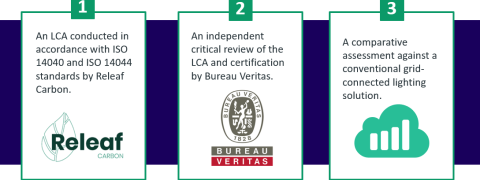
Our approach was based on three key steps:
1 - Conducting a Life Cycle Assessment in accordance with ISO 14040 and ISO 14044 standards through a certified environmental consultancy.
2 - Independent critical review and certification by Bureau Veritas.
3 - Comparative analysis against a conventional grid-connected public lighting solution.
This methodology provides transparent, verifiable, and comparable results.
What is a Life Cycle Assessment?

A Life Cycle Assessment (LCA) measures the environmental impacts of a product throughout its entire life cycle.
The assessment takes into account:
-
Component manufacturing
-
Transportation
-
Installation
-
Use phase
-
End-of-life treatment and recycling
For our Smartlight solar streetlights, the assessment was conducted over a 40-year reference period, corresponding to the longest service life of the components included in the study.
The Results of Our Life Cycle Assessment

The study demonstrates that, in France, a Smartlight solar streetlight emits twice less CO₂ than a conventional grid-connected streetlight.
This significant reduction is mainly due to the absence of a grid connection and the eco-design choices implemented throughout the product's development.
By installing Fonroche Lighting solar streetlights, you actively contribute to reducing your carbon footprint:
In France: one solar streetlight over a 40-year lifespan saves 2 tonnes of CO₂, equivalent to one car journey from Paris to Beijing.
In Europe: ten solar streetlights over a 40-year lifespan save 60 tonnes of CO₂, equivalent to driving around the Earth seven times.
Understanding Where Emissions Come From

The Life Cycle Assessment shows that 97% of CO₂ emissions are generated by raw materials and their associated manufacturing processes. These findings highlight the critical role of eco-design and component selection in reducing the environmental impact of public lighting infrastructure.
Eco-design at the Core of Our Approach
Reducing environmental impact starts at the design stage.
Our solar streetlights are developed with several key objectives:
- Maximize equipment lifespan
- Optimize battery technologies according to project requirements
- Prioritize recyclable components
- Reduce maintenance requirements
- Minimize CO₂ emissions throughout the product's life cycle
Our products last more than 10 years without any maintenance
Products Designed for Recycling

End-of-life management is considered from the very beginning of our product design process.
Our solar streetlights are engineered to maximize the recovery and recycling of their components:
-
Photovoltaic module: 99% recyclable
-
LED luminaire: 100% recyclable
-
Battery: up to 99% recyclable, depending on the battery technology
-
Electronic control board: 95% recyclable
Fonroche Lighting is also a member of several certified recycling organizations specializing in the recovery and recycling of end-of-life components.
Lighting More Sustainably

Beyond reducing CO₂ emissions, our approach also aims to minimize the environmental impact of public lighting.
Our solutions are designed to:
-
Optimize light distribution through dedicated photometric lenses
-
Adjust lighting levels according to actual needs
-
Precisely control luminous flux
-
Use application-specific colour temperatures
-
Preserve biodiversity and protect the night sky