Coastal areas: solar LED streetlights facing wind and corrosion
Along coastlines, development projects are multiplying: seaside promenades, marinas and industrial ports, breakwaters, and heavily used pedestrian routes. In these environments, public lighting does more than simply provide visibility; it enhances nighttime safety, supports orientation along routes, improves user comfort, and integrates into often delicate coastal landscapes.
However, coastal environments impose specific constraints: salt-laden air, sea spray, persistent humidity, occasional strong winds, sand, and other coastal stresses. These conditions require equipment designed to withstand long-term exposure, including harsh weather events.
This context regularly raises the same question: is autonomous solar street lighting truly suited to coastal environments, and how does it perform over time?
Which weather conditions most affect coastal solar lighting?
Most malfunctions are caused by two main stress factors:
-
Salt, sea spray and saline mist
Salt penetrates all interfaces: screws, mounting plates, covers, connectors, and microcracks. Over time, repeated exposure and accumulation of salt deposits, rather than single weather events, cause most damage. -
Wind and vibrations
On breakwaters and seafronts, gusts and turbulent airflows place extra loads on poles and assemblies, requiring careful anchoring and durable connections such as plates, fasteners, and structural components.
Is photovoltaic lighting suitable for coastal areas?
Yes, provided that materials and design are adapted to withstand coastal conditions.
This requires robust solutions. Durability depends on careful technical choices and materials suited to exposed environments, ensuring mechanical resistance, corrosion protection, and long-term performance under harsh coastal conditions.
The main risk in coastal areas is saline corrosion. Salt carried by marine air and sea spray accelerate oxidation, particularly at vulnerable points such as fixings, interfaces, edges and connections.
Mechanical stresses are the second key risk: gusts, vibrations, impacts, and sand abrasion can damage components. Humidity and condensation may also affect parts if the luminaire design does not account for these conditions, especially during repeated extreme weather events.
How do Fonroche Lighting solar solutions withstand coastal conditions?
Resistance is based on two essential pillars: design and testing.
Extensive testing to maximize durability
Fonroche Lighting highlights its approach to climatic testing and accelerated aging. The Power Room is a dedicated facility where products undergo corrosion and salt spray simulations. To date, more than 40,000 cumulative hours of testing have been completed, validating new battery technologies and ensuring product performance under various climatic conditions.
In addition, poles and mechanical components are regularly tested to simulate cyclonic winds and other extreme stresses, verifying structural integrity under severe conditions.
Durability in saline environments: materials and finishes
In coastal environments, the durability of public lighting depends primarily on material selection and design quality.
Metal components
All steel parts are made from stainless steel or hot-dip galvanized steel, ensuring a high level of corrosion protection.
All rods used in Fonroche solutions are 100% hot-dip galvanized.
Other metal components are made from aluminum, a material naturally resistant to corrosion.
Coatings and finishes
Products are coated with a high-durability polyester powder finish (QualiCoat Class 2).
This finish ensures long-term resistance to outdoor conditions but is not a standalone anti-corrosion solution.
Fixings and assemblies
Assembly points are particularly vulnerable in saline environments. Careful selection of materials for fasteners, mounting plates and interfaces, combined with high-quality finishes, is essential to limit corrosion and maintain mechanical strength over time.
Energy autonomy and performance
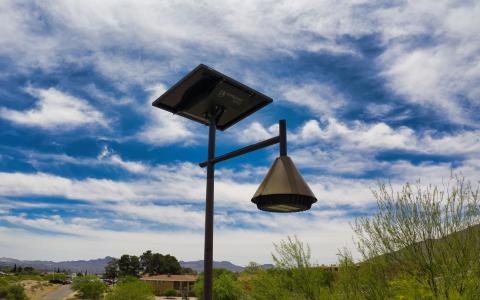
Autonomous solar lighting operates by managing three key parameters: photovoltaic production, battery storage, and LED consumption. This architecture provides full energy autonomy based on solar power allowing lighting to function without connection to the electrical grid.
The Smartlight solar pole range follows this approach, with a commitment to 365 nights of lighting per year.
Field-proven installations in coastal environments
Port of Saint-Gilles, Réunion Island, 2024
Installation of 80 solar streetlights as part of a port project designed to withstand harsh coastal conditions.
Mayotte, 2020
Deployment of 2,500 solar streetlights across the Mayotte archipelago, along National Road Kawéni and in Mamoudzou districts, meeting high demands for safety and lighting autonomy.
FAQ
Should solar photovoltaic lighting be avoided near the sea due to salt exposure?
No. However, autonomous solar lighting solutions must be specifically designed for coastal environments, with suitable materials and engineering that ensure long-term resistance.
What is the main weakness of public lighting poles in coastal areas?
Assembly points. Salt accumulates and attacks areas where components meet, such as fasteners, mounting plates and interfaces.
What provides the best protection against corrosion?
A combined approach works best: stainless steel, hot-dip galvanized steel, aluminum, durable finishes and regular inspections.
Can promenades or breakwaters be equipped without heavy construction work?
Yes. Autonomous solar systems typically eliminate the need for trenches and grid cabling, simplifying installation. In coastal areas, special care must still be given to anchoring, wind exposure and maintenance access to ensure reliable solar-based autonomy.