
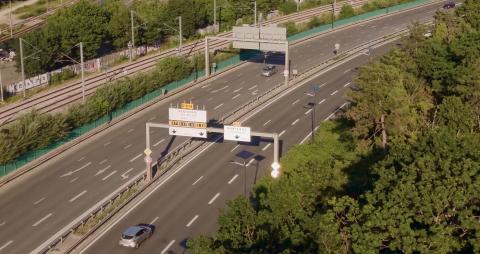
Renovating the public lighting of a complex road corridor without digging trenches, without cutting off traffic, and at half the cost of a conventional renovation: that's the bet successfully pulled off by the Hauts-de-Seine Department on the RD914, between Nanterre and Puteaux, at the gateway to La Défense.
This project is one of the largest deployments of autonomous solar public lighting carried out on public roads in Île-de-France. It offers concrete proof of the benefits of this technology for local authorities facing aging or faulty lighting networks.
The context: an obsolete network on a high-stakes section
The Boulevard de La Défense in Paris is a strategic dual two-lane road that serves the La Défense business district and runs alongside Paris Nanterre University.
On the section in question, the existing public lighting was at the end of its life: some streetlights were no longer even working. A conventional upgrade of the electrical network would have required major civil engineering work, particularly complex on this stretch, which includes several access ramps.
Faced with this situation, the department chose a technological break with the past rather than a traditional renovation: replacing the faulty lighting with fully autonomous solar streetlights, with no connection to the electrical grid whatsoever. Fonroche Lighting, the sector leader that has already carried out several large-scale projects in Île-de-France, was selected to deploy the project.
The solution deployed: 100 autonomous solar streetlights
Since May 2026, 100 new poles fitted with photovoltaic panels have been installed along more than a kilometer of roadway. Each light point operates in total independence thanks to a system combining three components: a photovoltaic panel for energy production, a storage battery, and an LED luminaire for light distribution.
Manufactured in southwestern France, each Fonroche Lighting autonomous solar streetlight captures solar energy during the day to power the lighting at night, and ensures continuous operation even during periods of low sunlight, particularly in winter, thanks to high-performance components and a unique approach that guarantees 365 nights of lighting per year.
Built-in intelligence: remote management for energy efficiency
Beyond energy autonomy, these fixtures include remote-management features that allow the light intensity of each point to be adjusted remotely. This dimming capability serves a dual purpose: limiting light pollution in a dense urban area while ensuring a lighting level suited to the road's actual needs, particularly near merging zones and interchanges.
The results: safety, speed, and budget control
The project represented an investment of around €750,000 for the department, a cost presented as half of what a conventional renovation connected to the electrical grid would have required.
The gap is easily explained: no trenches to dig under the roadway, no continuous electrical connection to install on an otherwise complex section.
This technical choice also had another decisive advantage for such a heavily used road: speed of execution. The absence of heavy civil engineering work made it possible to install the equipment without significantly disrupting traffic — a major consideration on a dual two-lane stretch serving La Défense.
On the safety front, the Department reports improved visibility on the roadway and on structures, as well as clearer visual reading of merging zones for road users. The absence of electrical cabling also reduces the risk of network-related outages and limits exposure to copper theft, a phenomenon on the rise in recent years on public lighting infrastructure.
A project rooted in a long-term energy transition strategy
This initiative is part of the Hauts-de-Seine's Agenda 2030, its roadmap for sustainable development and energy transition. The Department presents this rollout as a test-value experiment: if performance holds up over time in terms of reliability and maintenance, extending the system to other road sections in the territory is already being considered.
Why this case study is a benchmark for local authorities
The RD914 project addresses a challenge many local authorities face today:
How can an aging public lighting network be modernized on complex infrastructure (structures, ramps, dense urban sections) without incurring the cost and delays of a conventional electrical network renovation?
The answer provided by autonomous solar public lighting comes down to four points:
-
Controlled cost: up to 50% savings compared to a grid-connected renovation.
-
Speed of implementation: no trenches, no prolonged traffic disruptions.
-
Technical reliability: full autonomy even during periods of low sunlight.
-
Smart control: remote management to adjust light intensity and reduce light pollution.
For local authority technical departments, engineering firms, and developers facing similar constraints, this case study demonstrates that autonomous solar public lighting is no longer an experimental solution reserved for isolated sites, but a credible and economically advantageous alternative — including on structuring, heavily used road corridors.
Fonroche Lighting supports local authorities in their public solar lighting projects, from feasibility studies through to on-the-ground deployment.


