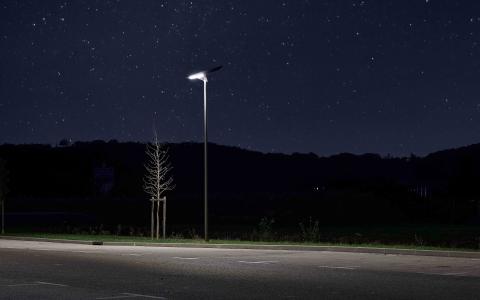
A bright future for solar lighting
The conversation has heated up in recent months around the environmental impact of public policies, industry and our own lifestyles and choices. Caring for our planet isn’t just a trend. There’s a growing awareness of the damage we’re doing — and this is reflected in increasingly tight legislation.
Faced with ever greater economic as well as environmental constraints, local authorities and public and private sector companies alike are adopting more ecologically responsible behaviours — including transitioning to solar lighting. The number of off-grid streetlights has risen significantly in the last five years, and solar is gaining real recognition as a sustainable solution with a bright future.
Grid or solar?
Grid-tied lighting is still the preferred choice for many, but it involves a lot more work. Before installation, contractors have to dig up the road and lay miles of cable, causing disruption at huge expense for taxpayers. Once installed, conventional streetlights need regular maintenance to keep them working properly. Despite this, they’ll still need replacing after 30 years or so. Added to costly installation and maintenance, there’s the price of the electricity they use, which has risen 40% in the last five years and will likely keep going up.
Compare with solar streetlights. They’re quick and easy to install, with no trenching or cabling work. No maintenance is needed and there’s no electricity bill, since they’re entirely off-grid. Simple, cost-effective, kind to the environment — it’s the alternative solution of choice for businesses and smart cities keen to reduce their ecological footprints.
In today’s new paradigm, public lighting must do much more than simply ‘be there in the background, providing reassurance’. It needs to perform consistently brilliantly, whatever the time of day or night. This requirement is reflected in the European EN 13201 standard, which measures the performance of grid-powered and solar lighting systems.
Talkin’ bout a solar revolution
Delivering powerful illumination on a par with grid-connected systems, solar lighting is a real gamechanger. Aware of the benefits, an ever growing number of businesses and authorities are transitioning to our eco-friendly solutions.
A shining example is right here in Morocco. The roads around the Ouarzazate Solar Power Station — the world’s largest solar farm — are lit by solar streetlights, conveying a positive image of this impressive scheme while reducing its environmental impact.
The advent of LED lighting a few years ago was a decisive first step forward, delivering environmental benefits and cost savings. But much more progress is needed. Like LED technology, solar lighting is gaining ground: we now understand the ecological and economic impacts of our energy consumption, and this is increasingly reflected in our choices.
Governments, local authorities and businesses are steadily stepping up their efforts and driving progress on the energy front, reducing their carbon footprints and embracing cleaner alternatives. In this necessary push to be more environmentally responsible, solar lighting — with its clearly proven benefits — is beginning to outshine and overtake conventional grid-connected systems as the solution of choice for smarter, more environmentally aware businesses and local authorities the world over.